
Artists Celebrate Summer Solstice
at Labyrinth in Burlington
At the end of the 1960’s, a group of artists were disenchanted by the commercialism and objectness of art. They saw galleries and museums dictating the creative process, and, inspired by minimalism and concept art, decided to rebel. They held a group exhibition at the legendary (and heiress-run) Dwan Gallery. Willoughby Sharp curated an exhibition at Cornell University. And an up-and-coming Robert Smithson wrote an essay that, in addition to outlining a critical framework for making earth art, said, “A bleached and fractured world surrounds the artist. To organize this mess of corrosion into patterns, grids, and subdivisions is an esthetic process that has scarcely been touched.” By 1970, Smithson had completed his influential work, Spiral Jetty, and the earth art movement was born.
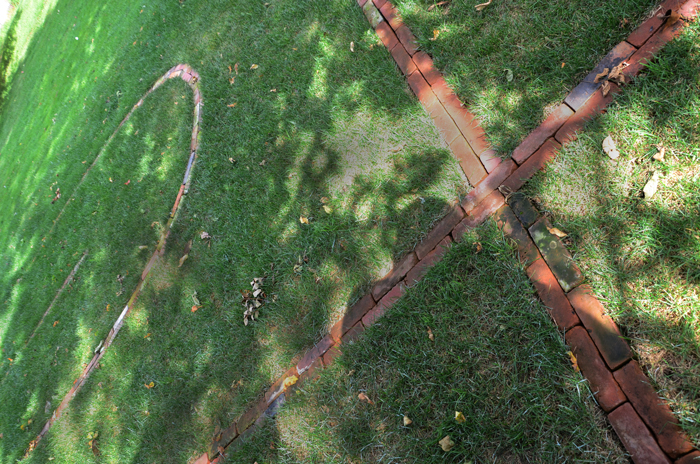
On September 7th, 2014, the Unitarian Universalist Church on the top of Church Street in Burlington inaugurated the city’s first and only piece of earth art. The Seven Circuit Classical Labyrinth is a permanent brick and grass installation on the southwest lawn of the Church. The labyrinth is made from over 3,200 new and used bricks collected from various sources and is under an ash tree. The walking path itself is grass, with the bricks delineating the lines.
A temporary labyrinth was first marked out during First Night 1999. In 2013, a task force, consisting of members Carol MacDonald, Jane Packard-Bryant, Pamela MacPherson, Jen Kristel, Barbie Alsop, Brian Haas, Ron Redmond, and Bob Furrer, raised funds and gathered materials for a permanent labyrinth. The construction was done by Rob Schantz of Creative Landscaping.
“A labyrinth creates a sacred space for walking meditation on a unicursal path that leads into the center and back out,” said MacDonald. “It is a tool in the quest for healing and wholeness. For centuries it has been used for meditation, prayer, personal and spiritual growth, ritual, and initiation.”
Labyrinths have been around for thousands of years. The Classical Seven Circuit labyrinth dates back to circa 200 BCE. The labyrinth was adopted by Christianity in the Middle Ages. An eleven circuit labyrinth was placed at Chartres Cathedral in France when it was built in 1201. Besides Burlington’s labyrinth, there is an eleven circuit labyrinth at All Saints Church in South Burlington and a seven circuit labyrinth at All Souls in Shelburne. The UU Community Labyrinth is open to the public and is available for walking at any time. Robert Smithson would be proud.
In honor of the Summer Solstice, artist Carol MacDonald and others are hosting a Labyrinth Walk with a celebration in the Native tradition led by Dee Bright Star, Abenaki Elder and Michael Watson, shaman. The event will take place on Monday, June 20th at 5:30PM. It is free and open to the public.
Need more information, send an EMAIL to Carol MacDonald.
PURCHASE THE MAGAZINE
In the magazine’s print edition, Carol MacDonald reflects on identity, feminism, and her artmaking in her commentary, “Tugging on Threads”.
To read the article and other news about art in Vermont, purchase Vermont Art Guide #1 or SUBSCRIBE to never miss an issue.
Submit your news, events, and artwork to Vermont Art Guide.